Understanding Artificial Intelligence: Transforming Our Future
Explore the fascinating world of artificial intelligence (AI), its evolution, applications, and the challenges it poses to society. Discover how AI is transforming industries and shaping our future.

What is Artificial Intelligence?
Artificial Intelligence (AI) is a branch of computer science focused on creating systems capable of performing tasks that usually require human intelligence. These tasks can include learning, reasoning, problem-solving, understanding natural language, perception, and more.
The Evolution of AI
AI has transformed significantly over the decades. From its early concepts in the 1950s to the sophisticated systems of today, we have witnessed incredible advancements. Here’s a brief timeline of AI evolution:
- 1956: The Dartmouth Conference marks the birth of AI as a field.
- 1980s: The rise of expert systems that mimic human decision-making.
- 2000s: Introduction of machine learning, particularly deep learning.
- 2020s: AI begins to permeate daily life, influencing various sectors.
Applications of Artificial Intelligence
AI’s applications are vast, and they continue to expand in numerous fields. Here are some notable examples:
1. Healthcare
AI is revolutionizing the healthcare industry by providing more accurate diagnoses and personalizing treatment plans. For example, AI algorithms are being used to analyze medical images to detect diseases such as cancer at an early stage.
2. Finance
In finance, AI systems are applied for fraud detection, risk assessment, and algorithmic trading. These systems analyze vast amounts of data to identify patterns that humans might overlook.
3. Transportation
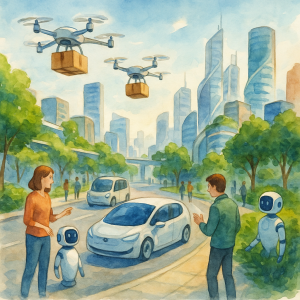
The development of autonomous vehicles is one of AI’s most exciting applications. Self-driving cars utilize machine learning and computer vision to navigate safely, potentially transforming how we think about transportation.
Challenges and Ethical Considerations
Despite its many benefits, AI presents several challenges and ethical dilemmas:
- Job Displacement: As AI systems become more prevalent, the fear of significant job loss across various sectors is increasing.
- Privacy Concerns: The data used to train AI systems can include sensitive information, raising concerns about user privacy.
- Bias in AI: AI systems can inherit biases present in their training data, leading to unfair treatment of individuals based on race, gender, or socioeconomic status.
Moving Forward with AI
The future of AI is bright but requires responsible development and implementation. Stakeholders in technology, ethics, and policy must come together to create frameworks that harness AI’s potential while minimizing its risks.
Conclusion
Artificial intelligence is transforming our world in profound ways. While it offers numerous benefits, it is crucial to address the challenges it presents. By doing so, we can ensure that AI contributes positively to society and enhances our quality of life.